The foodtech sector is an emerging and dynamic sector dedicated to improving the entire food industry value chain sustainably. This intersection between nutrition and technology is changing the traditional food and beverage sector, prompting existing players to rethink many of their insights into manufacturing processes, consumers, and the market in general.

In recent years, Israel has positioned itself as one of the world’s FoodTech leaders, and it has succeeded. In just 70 years, it has managed to turn its threats into opportunities and become a world reference in innovation, responsible for some of the most disruptive and revolutionary technologies in multiple areas. 


Investing in Spain’s FoodTech Sector

In our country, investment in the foodtech sector has tripled in one year after national startups have raised 695 million euros in 2021, which is 220% more than the previous year, according to data from ICEX’s recent report. Thus, the Spanish ecosystem is the fifth foodtech ecosystem with the highest investment in Europe after Germany, the United Kingdom, France, and the Netherlands, offering numerous opportunities for innovation, some of which make this country a global benchmark.

Webinar Israel

Imagine how powerful these two ecosystems would be if they were connected? That’s exactly what happened during the webinar on February 22. The Foreign Trade Administration of the Ministry of Economy of the State of Israel engaged Eatable Adventures and leading Spanish corporations, such as Europastry and Pascual, to be part of the conversation and share best practices in open innovation.

Although we still have many challenges ahead of us, all levels of government, associations, clusters, and large food companies are working simultaneously to address them. We live in the era of collaboration, in which people, startups, investors, and administrations, are allied to build a better future; and of course corporations in the agri-food sector cannot miss this joint work.


Open Innovation Programs: Mylkcubator & Baking the Future

Startups in this sector are undoubtedly an engine of innovation that can bring a lot to the industry. In order to benefit from this, we need to create open innovation programs that identify the best startups to partner with, lay the groundwork for this collaboration, and channel joint efforts that benefit both parties.

Mylkcubator Companies of all sizes and nationalities are implementing programs along these lines every day. Important Spanish food companies have developed their open innovation programs, accelerators, and investment arms, such as Pascual’s Mylkcubator and Europastry’s Baking the Future. With these programs, companies can discover new business models, explore new channels with their consumers, reinforce the sustainability of their operations, diversify in categories or geographically and, above all, increase the efficiency of their business.

baking the futureThere are many ways in which companies in the sector work on open innovation, and it will depend a lot on the culture of the company, the position it is in, and the structure it has. In this regard, it is always helpful to have an ally who can advise the company on how to move forward, identify startups to work with, and lay the groundwork for collaboration with them, such as us, Eatable Adventures. 

If you want to know more about the Spanish foodtech sector, visit our recent article.

Ekonoke is a Madrid-based company with a disruptive business model. It produces hops of the highest quality, ensuring sustainability and reliability of supply, and developing climate-resilient agricultural solutions with the least use of resources.

We had the opportunity to talk with Inés Sagrario, CEO and Co-founder of Ekonoke, which participated in our Eatable Adventures Acceleration Program (EAA) in 2019. Read on to learn more about Ekonoke’s experience as part of the acceleration program.

Could you narrate Ekonoke’s journey since you’ve been part of our accelerator program?

Ekonoke joined the Eatable Adventures Accelerator Program in September 2018. Our original project had nothing to do with what we are now. Even the partners at the beginning told us the project wasn’t quite right, but that they were confident in our team. We made fundamental decisions together to put the project on a better track, becoming who we are now.

In the first place, we suffered some confluence of our work with the Eatable Adventures team and the alterations of climate change we had to face. In March 2019 there was a beastly heatwave in Madrid, passing 40 degrees in the greenhouse, which was not prepared for it. This led to a drop in production, making us unable to get to serve customers we already committed with.
During this time we realized we couldn’t continue working in a greenhouse, and we had to switch to indoor cultivation.

With support from Eatable Adventures, we also realized that our vertical garden model focused on Horeca was not a scalable project, but rather an artisanal one. Responding to what our restaurant clients requested, we made our first change by offering ready-for-harvest live mini-gardens. Through Eatable, we were introduced to a variety of events, and in one of them, we met our partners Tallos microgreens. In combining the two projects, the brand Ekonoke was born.
Simultaneously, we continued testing with crops that did not have climate risk, one of them being hops, which has led us to what we are today.


Walk us through your rebranding process decision, why did you decide to focus only on one type of crop, as well as only selling your products at a B2B level?

We put together the situation Ekonoke was in at the time. On the one hand, our mini-gardens were not being profitable. Despite receiving very positive feedback from customers, we didn’t have the level of repetition that we had envisioned in our pre-covid business model.

On the other hand, having already been working with hops and being in contact with breweries, we realized that the brewing industry faced an important challenge of supplying their raw material sustainably and reliably.

Putting these two situations together, the answer was clear. One of the strongest supporters of our decision to completely change our business model has been Jose Luis Cabañero, CEO of Eatable Adventures.  


What is the most valuable piece of advice you have received from Jose Luis in our Accelerator Program?

First of all, I would like to emphasize that the greatest advice I have received from Jose  Luis was not really during the Acceleration Program period. Once you are part of the program, you create bonds, connections, and relationships that last a lifetime. It is very valuable to have a team behind your project with a vision and the ability to guide and support you as you make future decisions.

Having said that, the biggest piece of advice he told us was to decide to focus on growing hops. It was hard to accept and put aside our mini-garden project, but after long conversations with Jose Luis, he made us understand that the future of Ekonoke was in being a hops company.


Where do you envision Ekonoke in the short and long-term future?

In the short term, we are already working to have our first commercial-scale hop growing facility in Galicia. We want to show the world that different types of crops can be grown in different ways, starting with hops, so that food and ingredients do not have to travel thousands of miles, but rather the knowledge and technology will do.

In ideally 4-5 years, we will have our indoor hop growing facilities available worldwide, being the leading company that has completely revolutionized the hop industry.


Spanish foodtech startups are attracting higher investments, even from initial rounds. As a result, investment in foodtech projects has experienced an important growth during 2021 reaching a total of 695 million euros. This represents a 220% increase compared to 2020, which demonstrates the potential of the foodtech sector in the coming years. 

The investment momentum is determined by a set of relevant factors: greater knowledge of the sector by non-specialized national investors, the entry of international venture capital with bets similar to those of more developed ecosystems, and access to larger rounds by more mature startups and scale ups. 


GLOVO

The Barcelona-based multi-category delivery startup landed the largest funding round for a Spanish startup earlier this year of 450 million euros. Glovo’s intention is to use the investment to expand their presence in their existing 20 markets, plus focus more on the Q-Commerce (Quick Commerce) division. 


BIOTECH FOODS

BioTech Foods is a Spanish start-up founded in 2017 with the mission of producing and commercializing cultured meat. JBS, the Brazilian meat giant, is looking to expand into the cultured meat sector and invested 36 million euros on BioTech Foods to enable the firm to build an industrial plant in the Basque Country with the main objective being to have the new plant ready in 2024, when commercialization is expected to begin. 


HEURA

Most famously known for their vegan chicken alternative, foodtech startup Heura received 16 million euros in funding. The funds will go towards developing vegan pork and increasing its global expansion, especially in the British and American markets. This investment came just weeks after Heura’s crowdfunding campaign that raised 4 million euros in just 24 hours. 


BIOME MAKERS

Biome Makers raised 15 million dollars to secure their position as a global leader in biological soil analysis. The funds will go towards accelerating the global expansion of BeCrop® as the industry standard for functional soil analysis and sustainable soil health recovery, and Gheom® as an independent assessment program measuring the impact of crop inputs and farming practices to support a personalized agriculture.


CROWDFARMING

CrowdFarming raised 15 million euros to facilitate the entry of new producers onto its platform, improve its logistics and help more producers obtain EU organic certification. The startup’s mission is to democratize the food supply chain through direct sales to the end consumer, for which they have developed a marketplace where customers can access products in this way.


Download Eatable Adventure’s Report THE STATE OF FOODTECH IN SPAIN 2021 here.


Spain has more than 400 Foodtech startups, being one of the major powers in the sector worldwide.

The agri-food sector is one of the engines of the Spanish economy, concentrating almost 10% of GDP, but we also have the opportunity to become a world power in innovation in the sector, thanks to “Foodtech”, a term with which any technology applied to the agri-food value chain is known. And this is demonstrated by the 2021 edition of the report on the State of Foodtech in Spain, a quantitative study that analyzes the sector that has been prepared for the second year by Eatable Adventures, one of the three leading foodtech accelerators globally.

2021 has been a great year for the entrepreneurial ecosystem in new technologies applied to food. Despite the difficulties suffered by the economy as a result of COVID-19, the net figure of 407 startups in the sector was consolidated, with 9% of them having been born this year. Spain is positioned as one of the main global powers in the sector, similar to France, ahead of the United Kingdom, but far behind the 900 startups in Israel or the 200 in Singapore, much smaller territories than our country. 

However, the most remarkable fact is the significant growth in investment received by these startups throughout 2021, reaching 695 million Euros, a growth of +220%, more than triple that in 2020. This figure places foodtech as the second category of investment in startups in our country, behind only transportation. Most of this investment takes place in very early stages (23% preseed and 46% seed). The 23% is in series A and only 5% in later stages or 2% in acquisitions. Glovo leads the highest round, with 450 million euros, followed by Biotech Foods with 36 million euros, Heura with 16 million euros and Biome Makers and Crowdfaming with 15 million euros each. 

Startups and the agri-food value chain

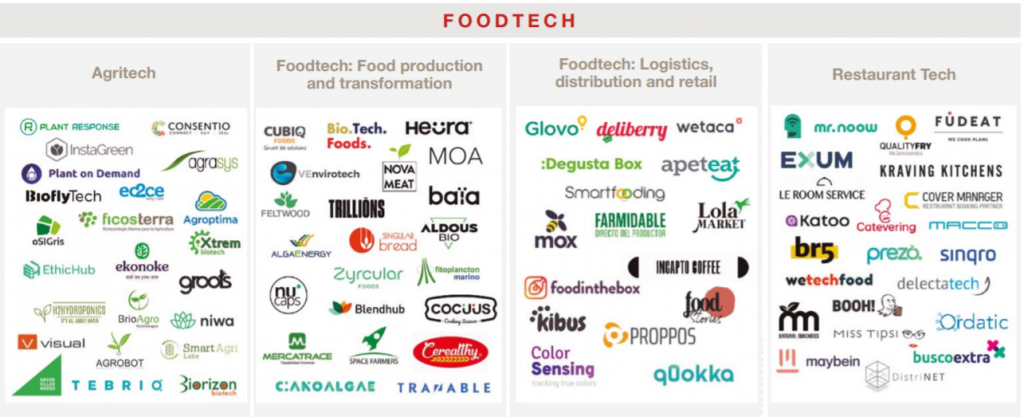
The concern of our entire society for sustainability, combined with the growing demand of consumers for healthier products, has been understood by the sector as great opportunities, increasing the number of startups that focus on the primary sector of the chain, on agriculture and livestock, seeking more sustainable formulas in production. Thus, 24% of startups work in agrifoodtech (vs. 17% in 2020), 35% in production and transformation, 24% in distribution and retail, and 17% in restaurant tech. 

Of those startups working in the primary sector, this year there is a greater weight in projects focused on the modernization of crops, applying software and automation in the processes (36%), while the weight of new methods of cultivation (18%) or the application of biotechnology in the fields (16%) is slightly reduced.

Analyzing the food process, which continues to be the most important point in the agri-food value chain (35%), there is a change in the search for new ingredients with which to produce alternative foods (47%), as opposed to plant-based or insect-based foods, which was the main driver until now (24%).

In the logistics section, the weight of direct-to-consumer models (74%), which in 2020 had gained very significant weight due to COVID-19, is slightly reduced. However, we see how many of these startups, which started out focused on the distribution of cooked food in restaurants (delivery), are expanding their catalogs to shift towards e-grocery.

Finally, in restaurant tech, we can clearly see how projects related to improved management thanks to artificial intelligence and the use of data are growing (40%), whereas until now this category was led by reservation platforms.

An important point of the study is the technology used in these projects. In 2021 we see how the use of biotechnology (32.05%) grows, mainly in food processing and crop improvement, but also Artificial Intelligence (28.21%) and Machine Learning (24.36%), in this case in a much more transversal way as they have applications in practically all points of the value chain. Robotics (12.82%) and Blockchain (6.41%) have a lower use in the volume of projects analyzed, for having a lower versatility and being more specific technologies but we see how there is growth compared to the 2020 report, confirming their consolidation as base technologies of foodtech.

It is important to highlight that 30.2% of the projects have patents, which helps to build a solid ecosystem with its own intellectual property that places our country in an opportune position of leadership, allowing us to export not only materials and processes, but also knowledge.

The profile of the entrepreneur is similar to that of the previous year: 40 years old, male (80%), starting up alone (14%) or with 1 partner (26%), and with less than 5 employees (46%), but 92% of them declare that in 2022 they will increase their workforce, confirming the employment generation capacity of the ecosystem.


What still needs to be improved, according to entrepreneurs

The study also includes a qualitative dimension that seeks to reflect the sector’s unfinished business. According to this, entrepreneurs state the importance of research centers in the development of startups in the sector (89% in 2021 vs. 65% in 2020), although it is perceived that universities do not fulfill this role, although this has improved slightly (50% in 2021 vs. 61% in 2020).

Knowledge of the sector by international investors is attributed as a reason why they invest in the sector (88% in 2021 vs 85% in 2020), which contrasts with the sentiment that the domestic investor lacks this knowledge, although this has improved this year (41% in 2021 vs 63% in 2020). It is important to highlight how the data reflects the change that the food industry is undergoing and is perceived as supporting the development of startups (67% in 2021 vs 43% in 2020).

And the point of subsidies is still pending, although it has improved. Entrepreneurs continue to demand greater ease of access to specific public aid for the sector (53% in 2021 state that this is a problem vs 72% in 2020).

For José Luis Cabañero, CEO of Eatable Adventures: “The tripling of investment data in 2021 and the significant volume of startups operating in our country show how the foodtech sector is confirmed as a great opportunity for the economy of our country, which will grow even more with the involvement of the public sector, corporations, research centers and universities”.

Download here the report and get to know more about our thriving food technology scene.

MOA Foodtech has obtained 1.5 million euros as a seed round to scale its production of sustainable proteins for food and expand to the Asian and American markets. This investment round was led by two IBEX 35 companies, plus the leading food accelerator in Southern Europe, Eatable Adventures, and Big Idea Ventures, the New York-based alternative protein fund.

Moa is founded by Susana Sánchez (CSO), who holds a PhD in microbiology and was previously the director of innovation of a biopharmaceutical company; José María Elorza (CFO), coming from the banking / M&A sector; and Bosco Emparanza (CEO), biochemist at the University of Navarra with an MBA in biotechnology companies. 


”Our current way of producing food is unsustainable. It causes 24% of greenhouse gases and 80% of deforestation, where 77% of the surface is used for animal feed. For this same reason, industry and society need sustainable and global solutions,” says Bosco Emparanza. ‘’Our mission is to produce sustainable and nutritious food. Right now we are working on developing foods using our ingredients in the dairy, meat and snack sector, among others.’’ 

Moa is committed to R&D and so far this year it has obtained nearly 400,000 euros in grants for the development of new technologies and applications.

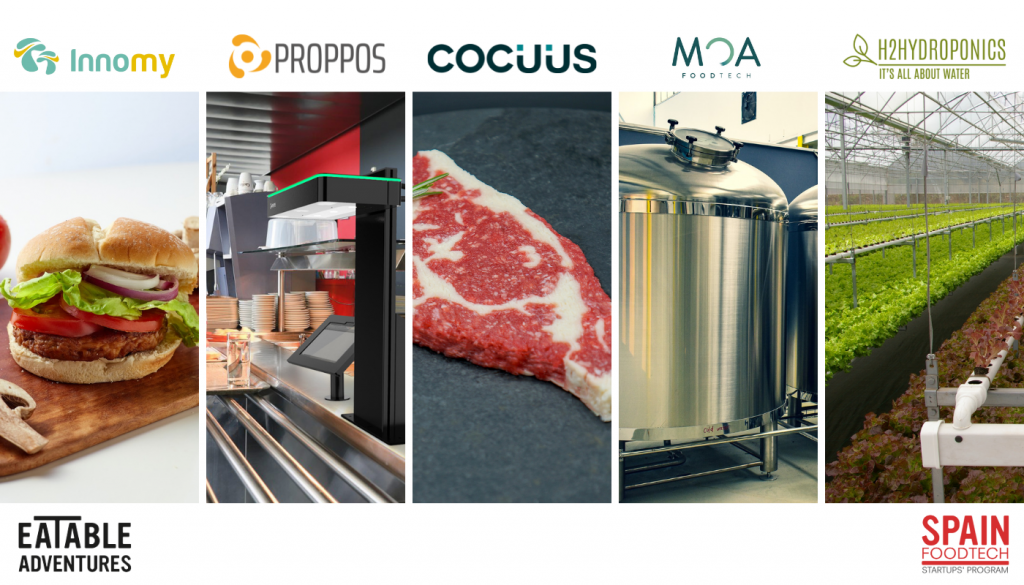
Moa foodtech, together with Cocuus, Proppos, H2hydroponics and Innomy are the finalists of the first edition of Spain Food Tech, the Eatable Adventures’ acceleration program supported by the National Center for Food Technology and Safety (CNTA) and ICEX Spain Export and Investment.

Moa has been awarded: Orizont award for the most innovative company, finalists in Leyton CES Challenge Las Vegas, winner of the Spanish stop of the `On The Road! Culinary Action´ of the Basque Culinary Centre.

The business incubator Madrid Food Innovation Hub was born with the mission of promoting disruptive food technologies and revolutionizing the global food industry in order to become a European reference center. This is the grand introduction of the new innovation and entrepreneur center developed by the Madrid City Council and located in the district of Villaverde. As the mayor, Jose Luis Martínez-Almeida, and the deputy mayor, Begoña Villacís, explained during the inauguration, the center is becoming one of the largest ecosystems of innovation and entrepreneurship in technology for the agri-food chain in Europe.

Madrid Food Innovation Hub is a pioneering experience in the world, whose objective is to revolutionize the global food industry. The center will develop several incubation and acceleration programs throughout the year, using different approaches and a deep training program for entrepreneurs in any area of the agri-food chain.

The innovation hub has a coworking space and a kitchen-laboratory of more than 300 m2, which is equipped with everything necessary to make concept tests, evaluation of prototypes and everything needed to develop projects. Madrid Food Innovation Hub activities, which include incubation programs, trainings and workshops with the district, will be completely free of charge for participants.

Almeida stressed that this new center is a clear example of how Madrid is capable of “reinventing itself”, since “here we were able to improvise the place from which thousands of meals for vulnerable people were provided” and, after just a few months, this has become “the place where we can reflect the will of the city of Madrid to win the future from innovation, talent and entrepreneurship”. In this sense, he stressed the need to support innovation by the administrations, assuring “that all those who want to start a professional and personal adventure in Madrid have in this City Council a faithful ally.”

As for Villacís, “we have the challenge of seeing how we are going to feed future generations” and for this “it is especially important that the Madrid City Council has thought about the need to create a council that is 100% focused on innovation”, something that, in her opinion, is beginning to be noticed “with projects like this, thinking, helping, creating, promoting and incubating companies that are going to dedicate themselves to thinking about how we are going to feed ourselves in the future.” According to the deputy mayor, the fact that Madrid is the second city in the world to assume this responsibility, behind Tel Aviv, “places us at the same level as the great European capitals and to be at the forefront of innovation.”

Promote entrepreneurship and innovation in the agri-food chain

With the collaboration of Eatable Adventures, one of the three largest foodtech accelerators in the world, Madrid Food Innovation Hub will work to promote entrepreneurship, supporting the ecosystem of Madrid startups in coordination with the strategy developed by the Delegated Area of ​​Innovation and Entrepreneurship that has led the capital to lead the ranking as the best Spanish city for entrepreneurship and as the sixth in Europe, according to the Financial Times.

After the inauguration of the space, Almeida y Villacís, together with the delegate of Economy, Innovation and Employment, Miguel Ángel Redondo; the delegate councilor for Innovation and Entrepreneurship, Ángel Niño and the councilor of Villaverde, Concha Chapa, have seen the work developed by the startups participating in the first incubation program of the hub and have tasted a menu designed by chef Íñigo Pérez ‘Urrechu’ and the Zalacaín R&D team that was made with raw materials from the foodtech startups: alternative proteins and vegetables grown in laboratories.

Baïa Food Co. is a Spanish startup that wants to improve the quality of life of people in our society. They mainly research on exotic fruits as a source of bioactive ingredients and develop functional food products with high added value. Among the startup’s key activities is the development of an ethical and sustainable value chain of a New Food from which a unique ingredient is extracted in nature with nutraceutical, food and cosmetic applications. The company currently markets a line of organic superfoods that come from small local crops where the different botanical species are endemic with the aim of positioning their brand “baïa” by opening different marketing channels.

In our conversation, Loan talked about the main difficulties they encountered while developing their business, especially as young entrepreneurs, and explained how they managed to overcome them. He also spoke about the evolution of the Spanish entrepreneurial ecosystem from when they started about 8 years ago until now and the support they had from the Israeli ecosystem that was already more mature. Regarding areas that can be improved, Loan believes that private investment and venture capital still have a long way to go in Spain.

In addition, since we have seen a great advance in AgriFoodTech in the last few years, we asked the co-founder about what that term means to him and how he would define it. According to him, “AgriFoodTech is a modern invention to bring together in a single term the entire food value chain (specifically plant-based) and the technology that is integrated into it to improve aspects of it. Agrifood covers from farm to table, in the traditional model of food production. The tech dimension refers to innovation in the chain, using and developing new technological tools that optimize chain management, improve productivity or the end consumer’s experience, create new and unlikely products, etc.”

You can find the full interview in Spanish here.

What is open innovation and why is it a good thing? 

The business world has seen unprecedented change that has been driven in large part by technology, changing demographics and the increasingly creative thinking of entrepreneurs and consumers themselves.  

Traditionally, corporations succeeded by creating a single product that became popular with the public and built more products around it. Research and development departments were exclusively focused on improving existing products, without ever looking outward.    

Today, however, there are more and more startups contributing with innovative ideas to the global marketplace, many of which have the potential to become major corporations that will change the world.  

It is easy to imagine how this inevitable reality can make traditional, established companies uncomfortable. However, instead of presenting a threat, startups can bring opportunity for all, thanks to the concept of open innovation, a term coined by Professor Henry Chesbrough, executive director of the Center for Open Innovation at the Haas School of Business at the University of California and co-founder of the Open Innovation Community. 

Open innovation is a way for companies to collaborate with startups, rather than compete with them. This includes incorporating new technologies and outside ideas that the startup can bring to the table, which has many benefits, as open innovation not only fosters creativity within corporations, but also serves to reduce internal investment in the R&D process. 

It is now a fact that when established corporations form alliances with startups, problems find solutions, a synergy that defines open innovation.

Internal innovation is the generation and implementation of positive and disruptive change at a specific time and environment. The difference from open innovation is that, during this process, the use of the company’s own resources is prioritized.

How does open innovation work? 

Open innovation can be defined as the process in which companies implement new opportunities to the existing business model. Currently, the most effective way to achieve this goal is through corporate alliances. 

There are multiple ways in which such alliances can achieve their goals, including through in-house research and development and through corporate accelerators. 

In a Plug and Play Tech Center study, 26 corporate alliances were analyzed, a majority of which have an innovation team of more than 20 people. Their main objective is to incorporate what is called proof of concept (POC). This is the process by which startups demonstrate to a corporation that their technology is economically viable. The startup must create a prototype to prove that its technology is capable of working on a large scale. 

If the startup demonstrates that it is viable through POC, proving that its product is safe, it can be integrated into the corporation’s business model. The innovation team is responsible for evaluating the startup during the testing phase to determine that it can move forward with the adoption of the new model. 

Open innovation in the agri-food sector

Innovation is always present in the agri-food value chain. We can find it in every of its phases, from agriculture to the restaurant’s service.

Open innovation is reshaping the agricultural outlook. Agriculture, more than any other industry, needs to update itself in the technological field. Advances in high-tech systems using drones, sensors, and data analytics have created a demand for expertise that isn’t often associated with [ag]. Consequently, most agricultural companies that still don’t take advantage of open innovation will do so by the end of this decade. The rest will not last much longer.

In respect of the food industry, studies have revealed that open innovation, collaborative networks and mergers and acquisitions can represent a viable perspective to increase competitiveness, customer satisfaction and sustainability.

An excellent example of open innovation in this sector is the case of Unilever, which invested 85 million euros in the creation of a new center called “Hive”. This center can be found in some of the most renowned academic research centers as well as emerging companies. Its location is Wageningen University. Unilever plans to make this the most important global food research center in the world.     

Technology also plays a central role with respect to cell cultured meats. According to Iñigo Charola, the CEO of Biotech Foods, a Spanish company working on the scale-up phase of cultured meat, “The food industry has always been very innovative, but I believe that, thanks to different technologies that are starting to be applied to the food sector, the future of this space will bring us a great variety of attractive, sustainable, healthy and safe products. I think this revolution is going to happen at an unprecedented level.”          

It is undeniable that there are more and more startups aspiring to supply the demand of the future, with more creative teams and innovative ideas that are revolutionizing the food industry globally. Traditional food corporations are taking notice of this big change, and they don’t intend to be left behind.    

What does Eatable Adventures have to say about open innovation? 

Open innovation is a formula that is gaining increasing traction as a model for adopting new talent, technology and disruptive business models. By embracing open innovation companies can literally transform their organizations, achieving goals that would otherwise be impossible without the use of these methodologies.

Eatable Adventures is one of the top three global food technology accelerators, with more than 20 open innovation programs launched, a deal flow of 1.400 foodtech startups analyzed each year and operations on three continents.

Eatable Adventures detects, promotes and invests in the most disruptive startups that promise a relevant impact on the agri-food value chain, through successful collaboration models with corporations in the food industry, generating innovation opportunities, in line with their strategic and business challenges.

Eatable Adventures has developed an entrepreneurial ecosystem in the food sector by a global community with more than 25.000 members and multiple events that bring together industry, investors, universities, governments and entrepreneurs of food innovation.

Reasons to collaborate with startups

The reasons why companies should collaborate with startups, i.e. embrace the concept of open innovation, are numerous.

  • Identify new business opportunities

Collaborating with startups can be the most effective way to identify new business opportunities. Startups usually have younger teams, with fresher ideas and different perspectives, a good area to find opportunities that many long-established companies didn’t think about.

  • Reduce generating innovation’s risk and cost

Partnering with a startup lowers the risk of innovation since startups, if they have enough experience in the market, can prove that their innovative products are something the public wants. It has also been shown that collaborations with startups decrease the cost of innovation generation.

  • Accelerate the innovation process and time to market

Startups also accelerate the innovation process, because they are usually composed of young, creative and ambitious teams that already have a clear vision for the future of their products and business model.

  • Improve internal creativity

Open innovation progresses internal creativity of established companies as they inspire and motivate teams with the flow of new ideas and perspectives. Positive changes and new goals are often a great motivator for established companies.

  • Improve competitive position

Open innovation boosts the competitive advantage of the companies. This is obvious when you know that open innovation consists of the implementation of new technologies acquired from a very broad group of creative and experienced innovators outside the company.

The State of European Food Tech 2021 – Five Seasons Ventures + Dealroom

Companies that have taken the leap to open innovation

There are countless success stories of companies and organizations that have taken the leap to  open innovation to grow their own business and change the global food industry. Here we will mention a few that have left behind the traditional and conformist way of innovating to embrace this multifaceted model of the future.

We think that sharing some cases of open innovation that we have developed together with our clients is the best way to show its disruptive potential in this world.

Pascual Innoventures

Mylkcubator

For several decades, the Pascual family of Spanish entrepreneurs were involved in the traditional dairy industry through their company Calidad Pascual S.A.U

However, with the overwhelming growth of plant-based foods and milks in recent years, and the number of startups taking advantage of this shift to supply the demand, the Pascuals created Pascual Innoventures, a company whose goal is to drive the foods of the future. Through Pascual Innoventures, the Pascuals launched Mylkubator, a global incubator specializing in the development of innovation projects for the dairy sector, in collaboration with Eatable Adventures. 

“The entrepreneurial and innovative spirit is in our genes, it comes from the values that my grandfather instilled in us to be nonconformist, dream big and dare to take risks, not only with our heads but also with our hearts. This is how Pascual Innoventures was born, with a long-term vision and the goal of giving our best for the future of food. We will work hand in hand with startups that allow us to move into the future,” says Gabriel Torres Pascual, one of the creators of Pascual Innoventures.

In 2020, Pascual Innoventures, in collaboration with Eatable Adventures, launched another call for projects, the Plant-based Dairy Challenge, to search for the best startups in the plant-based dairy ecosystem.

Europastry

Another example is the case of Europastry, an international supplier of bakery foods. The company has created Cereal, the new bakery and pastry R&D center, through which it launched the Baking the Future initiative with Eatable Adventures in 2019. The latter is an industry accelerator whose goal is to identify innovative solutions generated by startups from every corner of the world and build an open innovation model for the company. After this first experience of collaboration with startups, the company has decided to launch an accelerator program in 2021 with the aim of identifying innovative solutions generated by startups in every corner of the world and building an open innovation model at Cereal.

For a period of six months, the program will help entrepreneurs develop their products, measure their viability in the market and assist in the creation of new business models, helping startups advance their projects.

Sigma

The food company Sigma has also partnered with Eatable Adventures to seek out entrepreneurs and promote high-impact projects in the food sector worldwide. This year it presented the second edition of Tastech by Sigma, the startup acceleration program whose first edition registered 123 applications from 19 countries, of which seven developed a pilot program and four will formalize a long-term alliance with Sigma. 

In the words of Daniel Alanis, development director at Sigma, “We want Tastech by Sigma to become a benchmark in the sector and for more and more entrepreneurs to present and develop their ideas with us. We are convinced that innovation in the food sector is a collaborative task, and this program is our contribution to young talent revolutionizing what we eat and how we produce it.”

The future of open innovation

By analyzing current market trends, we can predict that open innovation will continue to be an increasingly important factor in the global marketplace. The pace of technological advances is getting faster and more unpredictable, and corporations that do not embrace change and innovation run the risk of stagnating or becoming irrelevant.      

It is already a fact that innovation is indispensable to the success of modern and future corporations and is necessary to compete with other corporations and capture the attention of consumers.              

By fostering a mutually beneficial relationship with startups and, hence, their innovation teams, corporations can go far beyond just staying relevant. They can achieve their goals and remain key players in the marketplace for many generations to come. 

In collaboration with CNTA, we have put together a summary of the most relevant arguments made at the event Future Food Tech Alternative Proteins. Some of these are the potential of technologies such as precision fermentation or synthetic biology as ways to obtain protein alternatives, as well as predicting that this trend is likely to continue to grow.

CNTA, National Centre for Food Safety and Technology, is a private non-profit making association. Since 1981, the aim of this research centre has been to contribute towards improving the competitiveness and quality of the food sector. Its work is focused on the fields of food science and technology, biology, chemistry, agronomic engineering, food sciences and nutrition.

What is contributing to this acceleration in the so-called alternative protein revolution? Why, as experts and international foodtech leaders point out, are the “stars aligning”? Here we summarize some of the keys:

Technology boom helps: many breakthroughs in precision fermentation and synthetic biology

If there was one term redundantly mentioned at Future Food Tech Alternative Proteins it was “precision fermentation”. Undoubtedly, it is one of the trendy technologies to meet the challenge of the search for alternative proteins. During the event, it was predicted that its progressive implementation will make it possible to continue producing ingredients with technological and nutritional characteristics capable of matching and even surpassing animal sources.

It is also a sustainable and efficient technology, which are very valuable qualities considering that the food industry faces the challenge of mitigating its climate impact in the coming years. Thus, the progress that can be made in the application of precision fermentation will open up great opportunities in the food industry.

The food industry is also looking very closely at the potential offered by synthetic biology. Numerous startups are succeeding in creating very promising cell-based products. So far, cell-based alternatives are the ones that are best able to replicate whole cuts (steaks, chops, sashimi…), as they are able to offer the consumer organoleptic and nutritional qualities that practically match those of the “originals”. After all, as Michael Selden, CEO of Finless Foods, pointed out, “laboratory developments are managing to reproduce what really happens in nature”. Looking to the future, regulatory and price barriers remain to be overcome so that these products can have a real and extensive market penetration.

The strength of new sources: algae, fungi, SCP…

Little by little we will be seeing more products based on alternative proteins from a wide variety of sources. At Future Food Tech Alternative Proteins we were able to see examples of how, increasingly, sources are diversifying with interesting results and potential market implementation. From the commitment to algae varieties such as the red algae used by Triton Algae or the chorella used by Algenuity, to the commitment to mycelium by Meati Foods or the unicellular protein Euglena by Noblegen. These cases make it clear that there is life beyond plant-based sources.

future food tech alternative protein

Noblegen presenting its ‘Euglena’ SCP development at Future FoodTech Alternative Proteins.

Even so, work continues in the plant-based segment, where it is also possible to find sources other than the usual ones (chickpea, pea, soybean). To make this search more effective, the need for a better and more detailed knowledge of the nutritional properties of new plants or legumes was put on the table, applying technologies that make it possible to characterize the ingredients from a technological (texture, stability, etc.) and nutritional (amino acids, digestibility, etc.) point of view.

Greater knowledge will generate even more possibilities for diversification.

“There are startups that are scaling very fast”.

Sean O’Sulivan, of SOSV Imvestment, gave another of the keys that is contributing to the acceleration of developments and the expectation that new products can slowly make their way onto the agenda of more consumers. “There are startups today that are scaling very fast and that is a huge step towards success,” he said in the opening keynote at the congress. One of the reasons for that ability to scale is the fact that the most disruptive startups are counting on a solid technological base. This is also attracting the attention not only of investors but also of large companies in the sector. Looking to the future, everything suggests that this technological solvency will gradually increase and this will allow the innovation boom to be aligned with the investment boom, whose upward trend has been a constant in recent years.

The forecasts, therefore, continue to be very optimistic. With greater technological solvency, it will be possible to scale up and achieve products that can compete on price in the market, reaching a larger number of consumers. This is undoubtedly one of the keys to ensuring that the much-talked-about acceleration does not come to a screeching halt.

The food industry is facing a scenario in which it can connect with a consumer who is increasingly committed to sustainability and who sees alternative protein sources as a strategy in line with this commitment. If we add to this the fact that alternatives to animal protein are already an unavoidable part of the future agenda of institutions and administrations, the scenario is favorable for the “revolution” to consolidate its change of gear and reach cruising speed.

The original content was written by Mikel Arilla, CNTA’s Vanguard and Trends Technician, is available here.

The world is changing at a speed never before seen by mankind. The industrial revolution, which began at the end of the 18th century, was the initial trigger. However, the technological revolution, driven by the creation of the internet towards the end of the 20th century, was a major catalyst for the change we are currently experiencing.

The technologies we know are becoming more and more advanced. It seems that there is always a new virtual platform to revolutionize the way we communicate, a phenomenon that has grown stronger in the age of covid.

In parallel, the way we humans perceive food has begun to change in recent years, empowered by a greater awareness of the inefficiency of the traditional food system and its impact on the planet and animals. This change in perspective has naturally stimulated a shift in the global food supply.  This is where the crucial role of food technology, or foodtech, comes in.


What is foodtech?

Foodtech as a concept is nothing new. Our ancestors have been modifying food for thousands of years. Even the process of putting food in salt to preserve it can be considered a primitive manifestation of foodtech.

foodtech

However, foodtech as a term has had much greater relevance in modern times. It represents the sophisticated changes we are currently experiencing. Today’s foodtech is not a simple and concise term, but rather one that encompasses all those agents that apply technology to the agri-food value chain. From production to consumption of food, technology is bringing efficiency, safety, and a significant improvement in sustainability.

Foodtech nowadays goes far beyond the mere preservation and alteration of food. Indeed, it is a whole system that encompasses other technologies that converge to improve and streamline the food system of this century. Thus affecting innovation throughout the agri-food value chain.


FoodTech is the new internet

A few decades ago, the internet was the wave of opportunity to be seized. As of 2019, when Beyond Meat became the first foodtech IPO on the New York Stock Exchange, the plant-based food industry was cemented as the new wave of investment to take advantage of. That IPO was the most successful since Yahoo went public in 1996.

In 2019, investment in foodtech startups globally reached a value of $19.8 billion (AgFunder). Only in Europe, investment in startups in this sector grew 106% compared to the previous year. Being increasingly dominated by plant-based foods. 

In parallel, there is another sector within the foodtech sphere that is causing a stir worldwide, cultured meat. According to the global consulting firm McKinsey this industry will be worth approximately $25 billion by 2030. It will also be presenting opportunities within and outside the current food industry.

Although this area of foodtech is barely in its infancy, by 2020 cultured meat companies had already raised $366 million. Which is 6 times more than the previous year. As was the case with the internet a few decades ago, the foodtech sector is, and will increasingly continue to be, a major driver of the global economy.


Foodtech technologies

Today’s food technologies are numerous and will continue to evolve. The following are the ones with the greatest impact on foodtech:

Blockchain: Launched in 2011 to track bitcoin cryptocurrency transactions, blockchain is a system by which transactions can be made between people around the world without the need for intermediaries. 

Fermentation technologies: These are technologies for developing microbes to alter a certain substrate or produce specialized biomass. Humans have relied on fermentation processes for thousands of years to create and alter foods and beverages. 

Bioprinting: It consists of the application of microfabrication technologies to the production of textured foods with functional characteristics. It uses cells and biomaterials to create organ-like structures and allows the cells to multiply. This technology has very practical applications in foodtech, especially for creating meat-flavored plant-based or cultured cell-based foods.

Cell Cultured technology: Speaking of cultured cells, this technology is used for manipulation at the cellular level that allows the industrialization of cell lines. Cells are obtained through painless biopsy and are cultured to create a significant amount of meat. The process does not require slaughter or harm to any animals.

Internet of Things: This is the set of devices, communication networks, and central services that make it possible to obtain data and automate different systems. The wireless digitization of today’s food industry is key to system efficiency. Especially considering the need for instant communication from one system to another for food production. 

Robotics: Automates food creation and processing and can eliminate manual hazards on the production line. This technology increases the efficiency of food production in addition to improving quality.

Data Management: Information analysis and modeling systems using database technologies or artificial intelligence. For food production on a massive scale, the role of Data Management is key to maintain a reliable and updated record of each product that will enter the market.

Automated logistics: Used for autonomous driving, fleet logistics improvement, and last mile logistics. Overall, the warehouse automation industry is projected to reach a value of $27 billion by 2025 (LogisticsIQ latest market research study).

E-commerce: This technology consists of technological tools that enable the implementation of electronic intermediation systems, both between companies and individuals. It is estimated that e-commerce revenues for the food sector will exceed 25.7 billion dollars in the U.S. by 2025.

Novel Foods: New ingredients and forms of production for the creation of foods with a healthier and more sustainable profile. According to the European Commission, Novel Foods are those that were not consumed before May 15, 1997, when the first regulation for Novel Foods was implemented.

Packaging: The elements for the protection and preservation of food in a healthy state, eliminating petroleum products. Many corporations are focusing on the implementation of ecological and biodegradable packaging. In addition to the reduction of excessive materials to protect food in the market.

Foodtech in Spain

Food plays an integral role in Spanish culture. It is no wonder the country keeps producing more and more foodtech startups. The gastronomy sector represents up to 33% of Spain’s GDP, according to a report by the multinational consulting firm KPMG.  

In Spain, there are approximately 400 startups in the foodtech sector, according to the report “The state of foodtech in Spain 2020” by Eatable Adventures. These companies are very young, as more than 60% are less than three years old. Also, 13% were created in the last year, at the height of the pandemic. Moreover, the majority (35%) are direct-to-consumer models, whose growth has skyrocketed in the wake of the pandemic.

foodtech

“Foodtech in Spain: Fuelling a More Sustainable and Efficient Food System” by ICEX

“Technology has allowed us to develop 100% vegetable meat that reduces gas emissions by 99% compared to animal meat. This will allow us to create the food system that society needs,” said Marc Coloma in an interview with Eatable Adventures.

Coloma is the co-founder of Heura Foods, the Barcelona-based vegan meat company that last month raised €16 million in an investment round.  

However, entrepreneurship in this field has yet to reach the stature of other powerhouses, such as Germany, Israel, or the United States.

“I think [in Spain] there have been important steps and initiatives to support entrepreneurship that favor the enrichment and development of the entrepreneurial culture from educational environments, but there is always room for improvement,” said Iñigo Charola in an interview with Eatable Adventures.

Charola is the CEO of BioTech Foods, another alternative protein company founded in San Sebastian, Spain in 2017.

There is no doubt that things are changing in Spain, and the foodtech sector is playing an increasingly important role in the country. In January 2021, the Spanish government invested €250,000 in NovaMeat, a company that prints plant-based steaks. Plus, it awarded €5.2 million to the aforementioned BioTech Foods for the development of cell-grown meat.  


The role of Eatable Adventures in the foodtech sector

Eatable Adventures promotes the Spain FoodTech Startup Program, an acceleration program whose purpose is to support the development of projects in this field with a solid technological base.

foodtech

This program -supported by the National Center for Food Technology and Safety (CNTA) and ICEX Spain Export and Investment – already has its five finalist startups. These are Cocuus (large-scale bioprinting of plant-based product analogous to traditional animal protein products); Proppos  (AI and computer vision to offer an unattended payment solution in foodservice and supermarkets); Innomy (animal protein substitute products based on mushroom mycelium cultivation); H2 Hydroponics (designs, operates and delivers at full capacity hydroponic vertical and indoor farming facilities in countries with extreme climates); and MOA foodtech (biotechnology and AI used to convert waste and by-products from the agri-food industry into a next generation protein with high nutritional value and is 100% sustainable).